Canine parvovirus is a highly contagious and fatal infectious disease in dogs. It primarily attacks rapidly dividing cells, especially intestinal crypt epithelial cells and bone marrow hematopoietic cells, and clinically manifests as vomiting, hemorrhagic diarrhea, and a significant decrease in white blood cell count. Dynamic monitoring of hematological changes is of great significance for early disease diagnosis, efficacy evaluation, and prognosis assessment.
01 Case background and medical history
-
Name: DingTalk
-
Age: 2 years old
-
Weight: 25 kg
-
Sex: Male
-
Breed: Golden Retriever
-
Medical history: Previously healthy, with no unusual medical history.
Chief complaint and physical examination: The dog returned home after being boarded at a pet store for one week. Within two days, it became lethargic, lost its appetite, and vomited once. Physical examination revealed lethargy, tenderness on abdominal palpation, and a body temperature of 38.8 ℃.
02 Initial examination and differential diagnosis approach
Based on the clinical symptoms, canine parvovirus infection is initially suspected, but it needs to be differentiated from canine coronavirus infection and acute pancreatitis. After communicating with the pet owner, the following tests were arranged for that day:
-
CPV and CCV colloidal gold rapid detection
-
Canine pancreatic lipase (cPL)
-
Anlu AI Formed Components Analyzer for Blood Testing
Test results showed: CCV and cPL negative; CPV weakly positive.
Given that the accuracy of colloidal gold test strips for various viruses is only 80-85%, and that false negatives or false positives may occur, a comprehensive analysis in conjunction with blood test results is necessary.
03 Day 1 of the course of the disease: Stress-induced blood count phase
Anlu AI Formed Components Analyzer Blood Test Results:
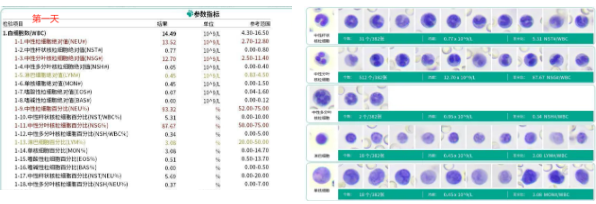
Results analysis: The complete blood count (left image) showed that the total white blood cell count was within the normal range, the absolute number of band neutrophils was normal, but the absolute numbers of neutrophils and segmented neutrophils were elevated, and the absolute number of lymphocytes was decreased. Based on the medical history, and after ruling out endocrine disorders and the use of steroids or other hormonal drugs, stress-related blood counts were considered the cause.
The leukocyte morphology segmentation image in the report (right image) shows that the leukocyte morphology is basically normal, with no abnormal signs of poisoning. Therefore, a definitive diagnosis of parvovirus infection cannot be made based solely on this blood count; continued dynamic observation is necessary.
Treatment plan: Isolation management will be initiated, and the sick dog will be housed in a separate cage; the environment will be disinfected daily by spraying with a 1:30 sodium hypochlorite solution; intravenous fluid replacement will be administered using lactated Ringer's solution at 80 ml/kg/day, divided into 3 infusions; and continuous monitoring of changes in clinical symptoms will be conducted.
04 Day 4 of illness: Acute progression phase
Clinical manifestations: The dog's condition worsened significantly, with loss of appetite, frequent vomiting and severe diarrhea. The feces were fishy-smelling and jelly-like. The eyes were sunken and the body temperature rose to 40.5 ℃.
Anlu AI Formed Components Analyzer Blood Test Results:
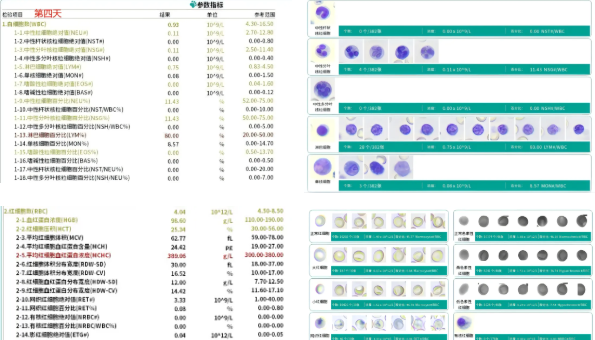
Results analysis: (1) Leukocyte lineage : As shown in the upper left figure, the total number of white blood cells, the absolute value of neutrophils and segmented neutrophils decreased significantly, indicating that the disease severely consumed a large number of white blood cells. The absolute value of band neutrophils was 0, which suggests that the infection may have caused abnormal bone marrow production. At this time, the dog's resistance was very low.
Observing the morphology of the white blood cell lineage in the upper right image, only 4 neutrophils with segmented neutrophils were found in the image database of this test sample, while 0 neutrophils with band neutrophils and multi-segmented neutrophils were found, indicating a sharp decrease in the number of neutrophils and a poor prognosis.
(2) Erythrocytes : As shown in the lower left figure, the total number of red blood cells, hemoglobin, and hematocrit are all low. The absolute value of reticulocytes has not increased, and the nucleated red blood cell count is 0. This suggests that hemorrhagic diarrhea and bone marrow suppression have led to non-regenerative anemia. The increase in mean corpuscular hemoglobin concentration suggests that there may be intracellular dehydration. The lower right figure shows an increase in the number of small red blood cells, which suggests that the red blood cell volume has shrunk due to dehydration, further proving the existence of dehydration.
Treatment plan: Continuous intravenous fluid resuscitation to correct hydration; montmorillonite powder for diarrhea; maropistan 1 mg/kg subcutaneously every 12 hours for emetics; canine parvovirus monoclonal antibody 1 mg/kg intramuscularly twice daily, combined with recombinant canine interferon 100,000 IU/kg subcutaneously once daily; ceftriaxone sodium 20 mg/kg intravenously twice daily to control secondary infections; and a single transfusion of 15 ml/kg of fresh plasma to correct anemia.
05 Day 7 of the course of the disease: Early stage of bone marrow recovery
Clinical manifestations: The patient's mental state has improved compared to before, the frequency of diarrhea has decreased, and no vomiting occurred after the first attempt to give a small amount of warm liquid food (20 g).
Anlu AI Formed Components Analyzer Blood Test Results:
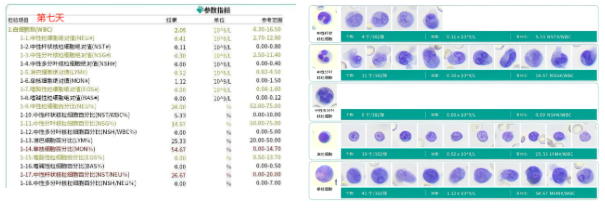
Results Analysis: As shown in the left figure, the total white blood cell count, neutrophil count, and absolute count of segmented neutrophils increased, but the white blood cell count remained at a low level, indicating that the patient is not yet out of danger and should not be complacent. The increased percentage of band neutrophils (NST/NEU%) indicates an increase in immature neutrophils, suggesting improved bone marrow production and a recovery in hematopoietic capacity. The right figure shows the detection of band and segmented neutrophils, also confirming bone marrow production. However, the irregular pleomorphic changes in the white blood cells suggest that the infection phase is still ongoing and requires continued treatment.
Treatment plan: Continue intravenous fluid replacement to correct hydration, and continue the antiviral and anti-secondary infection treatment plan. Try to increase the feeding of prescription enteral canned food and the frequency of feeding.
06 Day 8 of the illness: Recovery period and prognosis of inflammation
Clinical manifestations: The dog was in good spirits, without vomiting or diarrhea, voluntarily ate, its feces gradually became formed, and its body temperature returned to 38.5 ℃.
Anlu AI Formed Components Analyzer Blood Test Results:
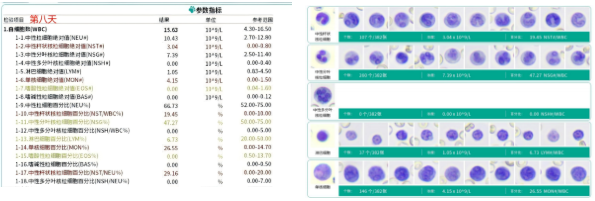
Results Analysis: As shown in the left figure, the total number of white blood cells and neutrophils has returned to normal, indicating that the bone marrow's ability to produce cells has recovered and the dog has basically passed the critical period. The elevated absolute number of band neutrophils indicates that the bone marrow is producing immature neutrophils, suggesting that there is an inflammatory demand in the body, indicating that the dog is still in the inflammatory phase. Since monocytes are mainly responsible for phagocytizing pathogens, clearing necrotic tissue, and participating in immune regulation, the elevated absolute number of monocytes at this time indicates that the inflammation has entered a chronic stage, so subsequent treatment should focus on anti-inflammatory therapy. The right figure shows that the morphology and number of white blood cells are basically normal.
Treatment plan: Explain the pet owner's condition and recovery progress; disinfect the pet's environment; continue oral anti-inflammatory medication after discharge; follow a low-fat, low-fiber diet for two weeks, supplement with probiotics; observe and record bowel movements; and have regular follow-up visits.
07 summary
This case study, through dynamic hematological monitoring and morphological verification throughout the entire course of canine parvovirus infection, clearly presented the disease's evolution from the stress phase, acute wasting phase, bone marrow suppression phase, to the recovery phase. The continuous changes in blood parameters not only provided important evidence for adjusting clinical treatment but also offered a reliable reference for disease prognosis assessment.
In the diagnosis and treatment of canine parvovirus, combining clinical manifestations, rapid test results, and dynamic hematological monitoring helps to achieve early identification, precise intervention, and efficacy evaluation, which is of great significance for improving the success rate of treatment.